Sample Focused-Response Assignments
Note: On the actual assessment, the extended-response assignments are delivered first, followed by the focused-response assignments.
Assignment 1
(Objective 0001) Understand major concepts and principles related to developmental and educational learning theories and apply this understanding to design curricula and instruction.
Assignment 1 is intended to assess your understanding of "Student Learning, Research, and Professional Practices," which is the first subarea of the Curriculum and Instruction assessment framework. Your response to Assignment 1 should relate to assessment objective 0001, "Understand major concepts and principles related to developmental and educational learning theories and apply this understanding to design curricula and instruction." Your response should be approximately 200– to 300 words.
Using your knowledge of how classroom learning environments influence the learning and development of all students, write an essay in which you:
- identify a consideration (e.g., environmental, social, linguistic, or organizational factors) related to the learning environment and describe how the consideration you identified could influence the learning processes within a classroom;
- describe an instructional strategy that could be implemented within the classroom environment you identified; and
- explain how this strategy could help to address the needs of individual students.
Sample Strong Response and Scoring Rubric for Assignment 1
An upper elementary classroom has a demographic representing a range of English language proficiency levels among students. Many students are in their first year attending school at the district and are new to learning English. This consideration would influence how students in the classroom learn vocabulary and acquire English language skills, and develop their knowledge of content. Instructional design and implementation including teaching methods, use of materials, communication with students, and the structuring of learning activities is essential for developing success for these learners.
Utilizing visual aids is a strategy considered best practice for instructing English language learners. A few ways to incorporate this would be posting vocabulary word labels around the classroom along with a visual portraying the word. For example, in the science center, a poster can display words associated with science equipment like microscopes or safety glasses along with corresponding images of those words. The poster could also include key procedural words used in science activities, such as "test" or "record," with images that align to testing and recording data. Content area instruction would need frequent use of visual supports such as videos, photos, graphs, and color coding of information. Learning activities could be established as a planned sequence of skills or tasks that could be presented and described using a checklist with visual graphics symbolizing each skill or task to be completed.
Visual aids help address the needs of all students, especially the student demographic that this classroom is composed of. Visual supports such as those mentioned help bridge communication between the teacher and students to promote greater access to vocabulary, content, and procedures. There is greater opportunity for each student to become independent to learn concepts and develop skills when visual aids are used.
Scoring Rubric
Performance Characteristics for the Assignment
| Completion |
The degree to which the candidate completes the assignment by responding to each specific task in the assignment. |
| Application of Content |
The degree to which the candidate applies the relevant knowledge and skills to the response accurately and effectively. |
| Support |
The degree to which the candidate supports the response with appropriate evidence, examples, and explanations based on the relevant content knowledge and skills. |
Score Scale for the Assignment
The four points of the scoring scale correspond to varying degrees of performance.
| Score Point |
Score Point Description |
| 4 |
The "4" response reflects a thorough understanding of the relevant content knowledge and skills.
- The response fully addresses all parts of the assignment.
- The response demonstrates an accurate, highly effective application of the relevant content knowledge and skills.
- The response provides strong, relevant evidence, specific examples, and well-reasoned explanations.
|
| 3 |
The "3" response reflects a general understanding of the relevant content knowledge and skills.
- The response addresses most or all parts of the assignment.
- The response demonstrates a generally accurate, effective application of the relevant content knowledge and skills.
- The response provides sufficient evidence, some examples, and generally sound explanations.
|
| 2 |
The "2" response reflects a limited understanding of the relevant content knowledge and skills.
- The response addresses at least some of the parts of the assignment.
- The response demonstrates a partially accurate, partially effective application of the relevant content knowledge and skills.
- The response provides limited evidence and examples or explanations, when provided, may be only partially appropriate.
|
| 1 |
The "1" response reflects little or no understanding of the relevant content knowledge and skills.
- The response addresses, few, if any, parts of the assignment.
- The response demonstrates a largely inaccurate, ineffective application of the relevant content knowledge and skills.
- The response provides little to no evidence, and if provided, examples or explanations are weak or inappropriate.
|
| U |
The response is unscorable because it is unreadable, not written to the assigned topic, is written in a language other than English, or does not contain a sufficient amount of original work to score. |
| B |
There is no response to the assignment. |
Assignment 2
(Objective 0002) Understand how to apply research to curricular and instructional decision-making to strengthen school programs and promote student learning.
Assignment 2 is intended to assess your understanding of "Student Learning, Research, and Professional Practices," which is the first subarea of the Curriculum and Instruction assessment framework. Your response to Assignment 2 should relate to assessment objective 0002, "Understand how to apply research to curricular and instructional decision-making to strengthen school programs and promote student learning." Your response should be approximately 200– to 300 words.
Using your knowledge of methods for evaluating, selecting, and using assessment instruments and techniques to support program-level evaluation, write an essay in which you:
- identify a specific curricular or instructional program and explain why it would benefit from a program evaluation;
- describe the implementation of an assessment instrument or technique that could evaluate the program you identified; and
- explain how the results of this evaluation could be used to improve program outcomes and educational practices.
Sample Strong Response and Scoring Rubric for Assignment 2
Across the district there appears to be growing concern on the effectiveness of the existing instructional program outlined to address bullying. It's become evident that a review of the program is necessary. Reasons for the program evaluation stem from an increase in communication from families and guardians stating that their children are being bullied both in school classroom settings and in less supervised environments such as school common area spaces, extracurricular events, or on social media platforms. Bus drivers have also submitted recent reports of bullying incidents, some of which involved physical altercations. Teachers share that students can be competitive but overall seem focused on learning.
Given the rise in reporting on bullying-related incidents, it becomes a priority to implement a process for the evaluation of data captured by the district's incident tracking platform. The platform used by district personnel to input a record of bullying incidents should already have an algorithm feature that points to patterns, trends, and the identification of areas that are high incidence or high risk. Consulting this data captured by the tracking tool allows the curriculum and instructional leader to make more informed decisions on components of the bullying program that need further development. For example, data may reflect that the majority of incidents submitted into the platform by teachers and staff occur outside of classroom space like hallways, cafeterias, and locker rooms.
By thoroughly assessing incidents, leveraging the right technology tools, and implementing effective instructional strategies within the existing program to diffuse bullying, the district can make a significant impact on their educational practices. The instructional program then has greater potential to be more impactful.
Scoring Rubric
Performance Characteristics for the Assignment
| Completion |
The degree to which the candidate completes the assignment by responding to each specific task in the assignment. |
| Application of Content |
The degree to which the candidate applies the relevant knowledge and skills to the response accurately and effectively. |
| Support |
The degree to which the candidate supports the response with appropriate evidence, examples, and explanations based on the relevant content knowledge and skills. |
Score Scale for the Assignment
The four points of the scoring scale correspond to varying degrees of performance.
| Score Point |
Score Point Description |
| 4 |
The "4" response reflects a thorough understanding of the relevant content knowledge and skills.
- The response fully addresses all parts of the assignment.
- The response demonstrates an accurate, highly effective application of the relevant content knowledge and skills.
- The response provides strong, relevant evidence, specific examples, and well-reasoned explanations.
|
| 3 |
The "3" response reflects a general understanding of the relevant content knowledge and skills.
- The response addresses most or all parts of the assignment.
- The response demonstrates a generally accurate, effective application of the relevant content knowledge and skills.
- The response provides sufficient evidence, some examples, and generally sound explanations.
|
| 2 |
The "2" response reflects a limited understanding of the relevant content knowledge and skills.
- The response addresses at least some of the parts of the assignment.
- The response demonstrates a partially accurate, partially effective application of the relevant content knowledge and skills.
- The response provides limited evidence and examples or explanations, when provided, may be only partially appropriate.
|
| 1 |
The "1" response reflects little or no understanding of the relevant content knowledge and skills.
- The response addresses, few, if any, parts of the assignment.
- The response demonstrates a largely inaccurate, ineffective application of the relevant content knowledge and skills.
- The response provides little to no evidence, and if provided, examples or explanations are weak or inappropriate.
|
| U |
The response is unscorable because it is unreadable, not written to the assigned topic, is written in a language other than English, or does not contain a sufficient amount of original work to score. |
| B |
There is no response to the assignment. |
Assignment 3
(Objective 0003) Understand the role of the curriculum and instructional leader as a professional resource and how to develop collaborative processes to strengthen instructional practices districtwide.
Assignment 3 is intended to assess your understanding of "Student Learning, Research, and Professional Practices," which is the first subarea of the Curriculum and Instruction assessment framework. Your response to Assignment 3 should relate to assessment objective 0003, "Understand the role of the curriculum and instructional leader as a professional resource and how to develop collaborative processes to strengthen instructional practices districtwide." Your response should be approximately 200– to 300 words.
Using your knowledge of problem-solving approaches in consultation and collaboration to promote student learning at the district level, write an essay in which you:
- identify a problem of instructional practice that may be present districtwide and explain the importance of consultation with district and building leaders regarding this problem;
- describe an approach to consultation with district and building leaders that would support improved instructional practice to address the problem you identified; and
- explain how collaboration at the district and building levels supports student learning and accomplishment of district goals.
Sample Strong Response and Scoring Rubric for Assignment 3
Evidence of student engagement levels during walkthroughs and classroom observations is lacking. This problem persists throughout the district. Consultation with district and building leaders regarding instructional practice in areas such as student engagement levels is important. Opportunities to consult the leadership team enable the district to examine root causes of instructional problems, and garner unified support to address this problem district wide. A collaborative focus on a district-wide problem will facilitate student performance for not just a classroom, grade level, or school, but for the district as a whole.
An approach taken by a curriculum and instructional leader to support improved instructional practice for student engagement would be to set up a meeting with district stakeholders such as administrators, specialists, department chairs, or grade-level leads. At this meeting, evidence of recent student engagement levels can be presented, followed by discussion, and result in surveys or a needs assessment on best ways to address the problem. The consultation should lead to an outcome that will provide teachers with resources to improve engagement in the classroom. Staff development training topics could encompass ways to improve the use of open-ended questioning techniques or the differentiation of lesson plans to accommodate various learning needs in order to improve engagement levels.
Collaboration to address instructional practice leads to effective implementation for accomplishment of district goals and support for student learning. Through consultation, stakeholders have improved communication pathways to generate relevant resources to address areas such as student engagement. Without efforts to consult and collaborate, there can be misalignment in executing district goals to address problems or areas of concern. Most importantly, outcomes for learning and students' progress will be enhanced because of this collaboration.
Scoring Rubric
Performance Characteristics for the Assignment
| Completion |
The degree to which the candidate completes the assignment by responding to each specific task in the assignment. |
| Application of Content |
The degree to which the candidate applies the relevant knowledge and skills to the response accurately and effectively. |
| Support |
The degree to which the candidate supports the response with appropriate evidence, examples, and explanations based on the relevant content knowledge and skills. |
Score Scale for the Assignment
The four points of the scoring scale correspond to varying degrees of performance.
| Score Point |
Score Point Description |
| 4 |
The "4" response reflects a thorough understanding of the relevant content knowledge and skills.
- The response fully addresses all parts of the assignment.
- The response demonstrates an accurate, highly effective application of the relevant content knowledge and skills.
- The response provides strong, relevant evidence, specific examples, and well-reasoned explanations.
|
| 3 |
The "3" response reflects a general understanding of the relevant content knowledge and skills.
- The response addresses most or all parts of the assignment.
- The response demonstrates a generally accurate, effective application of the relevant content knowledge and skills.
- The response provides sufficient evidence, some examples, and generally sound explanations.
|
| 2 |
The "2" response reflects a limited understanding of the relevant content knowledge and skills.
- The response addresses at least some of the parts of the assignment.
- The response demonstrates a partially accurate, partially effective application of the relevant content knowledge and skills.
- The response provides limited evidence and examples or explanations, when provided, may be only partially appropriate.
|
| 1 |
The "1" response reflects little or no understanding of the relevant content knowledge and skills.
- The response addresses, few, if any, parts of the assignment.
- The response demonstrates a largely inaccurate, ineffective application of the relevant content knowledge and skills.
- The response provides little to no evidence, and if provided, examples or explanations are weak or inappropriate.
|
| U |
The response is unscorable because it is unreadable, not written to the assigned topic, is written in a language other than English, or does not contain a sufficient amount of original work to score. |
| B |
There is no response to the assignment. |
Sample Extended-Response Assignments
Use the information provided to complete the assignments that follow.
Document A: Scenario
Ironwood City School District implemented a new middle school mathematics curriculum three years ago, and student outcomes have improved. A curriculum and instructional supervisor is now working with district leaders to monitor student academic performance and determine if adjustments to instructional practices and additional teacher learning are needed. The team focuses their review on Caledonia Street Middle School, where improvements in student performance have developed more slowly than other schools in the district, especially in the last two years. The school has been working toward improvement goals including increasing the percentage of students who perform at the levels of Proficient or Distinguished Learners on the Georgia Milestones end-of-year exam for grade 7 mathematics. Four years ago, under the old curriculum, 31% percent of the school's grade 7 students achieved scores within this range. The scores increased to 43% percent last year, and the school plans to increase them to 61% percent over the next 5 years to match the district's current performance.
Caledonia Street Middle School has 812 students enrolled in grades six through eight. Of the students enrolled, 62 percent are considered economically disadvantaged, 11 percent have a disability, and 8 percent are English language learners (ELLs). Caledonia Street Middle School's College and Career Ready Performance Index (CCRPI) scores are as follows: Content Mastery, 78; Progress, 86; Closing Gaps, 74; and Readiness, 86.
Document B: Assessment Data (Georgia Milestones)
The following graph shows the percentage of grade 7 mathematics students who scored at the levels of Proficient or Distinguished Learners on the Georgia Milestones End-of-Grade (EOG) assessment over the previous 4 years.
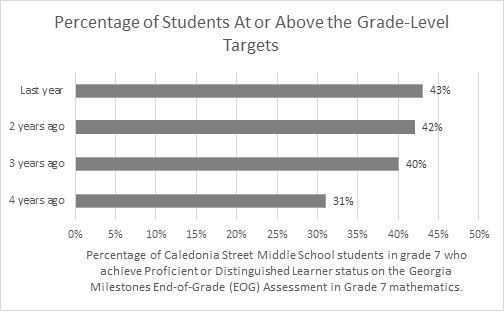
Horizontal bar graph titled Percentage of Students At or Above the Grade-Level Targets. The graph shows the percentage of Caledonia Street Middle School students in grade 7 who achieved Proficient or Distinguished Learner status on the Georgia Milestones End of Grade Assessment in Grade seven mathematics over the past four years. The horizontal axis represents the percentage of students, ranging from zero percent to fifty percent. The vertical axis lists the time periods Last year, two years ago, three years ago, and four years ago. The graph includes four bars, each representing a different year. Last year shows forty three percent of students meeting or exceeding the targets. Two years ago shows forty two percent of students meeting or exceeding the targets. Three years ago shows forty percent of students meeting or exceeding the targets. Four years ago shows thirty one percent of students meeting or exceeding the targets.
The following graph shows the distribution of scores for students across the state, district, and school who took the Georgia Milestones End-of-Grade (EOG) assessment for grade 7 mathematics last year.
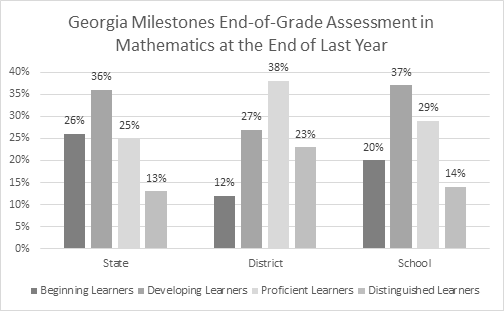
Bar chart titled Georgia Milestones End of Grade Assessment in Mathematics at the End of Last Year. The chart shows the performance levels of students on mathematics assessments across three different categories, labeled on the horizontal axis: State, District, and School. Each category is divided into four performance levels: Beginning Learners, Developing Learners, Proficient Learners, and Distinguished Learners. The vertical axis displays percentages ranging from zero percent to forty percent. For the State category, twenty six percent are Beginning Learners, thirty six percent are Developing Learners, twenty five percent are Proficient Learners, and thirteen percent are Distinguished Learners. For the District category, twelve percent are Beginning Learners, twenty seven percent are Developing Learners, thirty eight percent are Proficient Learners, and twenty three percent are Distinguished Learners. For the School category, twenty percent are Beginning Learners, thirty seven percent are Developing Learners, twenty nine percent are Proficient Learners, and fourteen percent are Distinguished Learners.
Document C: Instructional Materials
The following information summarizes Caledonia Street Middle School teachers' responses to questionnaires about mathematics instructional materials and approaches, administered during the first and third years in which they used the new curriculum.
Mathematics Instructional Materials and Approaches—Caledonia Street Middle School
(3 years ago, end of second quarter; 5 respondents, all of whom teach grade 7 math)
| How often do you use the following instructional approaches? |
Always |
Often |
Sometimes |
Never |
| I provide students with opportunities to explore real-life applications of mathematics using the STEM Explorations sections. |
40% percent |
40% percent |
20% percent |
0% percent |
| I assign the Additional Unit Practice Problems throughout the unit. |
40% percent |
40% percent |
20% percent |
0% percent |
| I present the Review Videos during class time. |
60% percent |
40% percent |
0% percent |
0% percent |
| I introduce new units using the Chapter Readiness Check pre-assessments. |
80% percent |
20% percent |
0% percent |
0% percent |
| I give time for students to collaborate to develop solutions to mathematics problems. |
60% percent |
20% percent |
20% percent |
0% percent |
| I differentiate instruction to meet my students' needs. |
40% percent |
40% percent |
20% percent |
0% percent |
| I use the curriculum's projects as part of my summative assessments. |
80% percent |
20% percent |
0% percent |
0% percent |
| I create my own worksheets and problem sets. |
0% percent |
40% percent |
60% percent |
0% percent |
| I create my own quizzes to monitor my students' progress. |
0% percent |
20% percent |
60% percent |
20% percent |
| I supplement the curriculum with my own projects. |
0% percent |
0% percent |
20% percent |
80% percent |
Comments made by 2 or more teachers:
- I like that the lesson plans for the curriculum are made for each day of school.
- The students are engaging with the new curriculum much more because they like the types of activities.
- The curriculum does a good job promoting conceptual understanding but does not give students enough opportunities to practice solving problems.
- I like how the curriculum teaches ratios and proportions, but I don't like how it teaches algebra concepts.
- The mathematical work is much more difficult in the new curriculum compared to the old curriculum.
- Students who have learning differences are not progressing as quickly as other students are in the new curriculum.
Mathematics Instructional Materials and Approaches—Caledonia Street Middle School
(last year, end of second quarter; 5 teacher respondents)
| How often do you use the following instructional approaches? |
Always |
Often |
Sometimes |
Never |
| I provide students with opportunities to explore real-life applications of mathematics using the STEM Explorations sections. |
0% percent |
20% percent |
40% percent |
40% percent |
| I assign the Additional Unit Practice Problems throughout the unit. |
20% percent |
40% percent |
40% percent |
0% percent |
| I present the Review Videos during class time. |
40% percent |
60% percent |
0% percent |
0% percent |
| I introduce new units using the Chapter Readiness Check pre-assessments. |
40% percent |
40% percent |
20% percent |
0% percent |
| I give time for students to collaborate to develop solutions to mathematics problems. |
40% percent |
40% percent |
20% percent |
0% percent |
| I differentiate instruction to meet my students' needs. |
40% percent |
40% percent |
20% percent |
0% percent |
| I use the curriculum's projects as part of my summative assessments. |
0% percent |
20% percent |
20% percent |
60% percent |
| I create my own worksheets and problem sets. |
0% percent |
60% percent |
40% percent |
0% percent |
| I create my own quizzes to monitor my students' progress. |
20% percent |
60% percent |
20% percent |
0% percent |
| I supplement the curriculum with my own projects. |
0% percent |
20% percent |
60% percent |
20% percent |
Comments made by 2 or more teachers:
- My students have been scoring much higher on the quizzes I make for them than the quizzes that are included with the curriculum.
- The curriculum emphasizes aspects of algebra that I don't think are important.
- I am using more of my own worksheets and assessments because I find those included with the curriculum materials are often confusing or too difficult.
- My class really isn't ready for the open-ended nature of some of the projects unless I modify them.
- The convenience of ready-made review activities makes planning lessons easier.
Document D: Student Performance Data
The following information summarizes Caledonia Street Middle School students' progress toward the Georgia Standards of Excellence in grade seven mathematics three years ago and last school year.
Georgia Standards of Excellence for Grade 7 Mathematics
7.NR.1 Solve relevant, mathematical problems, including multi-step problems, involving the four operations with rational numbers and quantities in any form (integers, percentages, fractions, and decimal numbers).
7.PAR.2 Use properties of operations, generate equivalent expressions, and interpret the expressions to explain relevant contextual situations.
7.PAR.3 Represent authentic situations using equations and inequalities with variables; solve equations and inequalities symbolically, using the properties of equality.
7.PAR.4 Recognize proportional relationships in relevant, mathematical problems; represent, solve, and explain these relationships with tables, graphs, and equations.
7.GSR.5 Solve practical problems involving angle measurement, circles, area of circles, surface area of prisms and cylinders, and volume of cylinders and prisms composed of cubes and right prisms.
7.PR.6 Using mathematical reasoning, investigate chance processes and develop, evaluate, and use probability models to find probabilities of simple events presented in authentic situations.
Progress Toward Georgia Standards of Excellence in Grade 7 Mathematics (3 years ago)
Average of the 7 Classes (175 students)
| Standard |
% percent of Beginning Learners |
% percent of Developing Learners |
% percent of Proficient Learners |
% percent of Distinguished Learners |
| 7.NR.1 |
37% percent |
35% percent |
15% percent |
13% percent |
| 7.PAR.2 |
29% percent |
40% percent |
20% percent |
11% percent |
| 7.PAR.3 |
28% percent |
40% percent |
20% percent |
12% percent |
| 7.PAR.4 |
30% percent |
43% percent |
17% percent |
10% percent |
| 7.GSR.5 |
29% percent |
40% percent |
20% percent |
11% percent |
| 7.PR.6 |
34% percent |
32% percent |
24% percent |
10% percent |
Progress Toward Georgia Standards of Excellence in Grade 7 Mathematics (last year)
Average of the 6 Classes (144 students)
| Standard |
% percent of Beginning Learners |
% percent of Developing Learners |
% percent of Proficient Learners |
% percent of Distinguished Learners |
| 7.NR.1 |
24% percent |
27% percent |
32% percent |
17% percent |
| 7.PAR.2 |
21% percent |
40% percent |
26% percent |
13% percent |
| 7.PAR.3 |
28% percent |
38% percent |
22% percent |
12% percent |
| 7.PAR.4 |
20% percent |
36% percent |
29% percent |
15% percent |
| 7.GSR.5 |
28% percent |
38% percent |
25% percent |
9% percent |
| 7.PR.6 |
20% percent |
36% percent |
29% percent |
15% percent |
Document E: Academic Learning Objective
The following information summarizes the school's plan to support the grade 7 mathematics teachers from the time the new curriculum was initially introduced 3 years ago until the end of the most recent academic year.
Academic Learning Objective—Mathematics
Smart Goal: In 3 years, students performing at the Proficient and Distinguished level of the grade 7 Georgia Milestones end-of-course assessment will increase by 21 percentage points, from 31% percent to 52% percent .
Data Analysis: Provide a brief explanation of the data analysis used to derive this goal.
Georgia Milestones: In the last year of the original curriculum, 31% percent of Ironwood City Middle School students were rated as proficient or distinguished learners of grade 7 mathematics. This exceeds the corresponding state value (28% percent ) by 3 percentage points but is 21 percentage points less than that of the district (52% percent ). The above smart goal can be attained by bringing the school's students' performance values in line with those from the district.
Action Plan: Over the course of 3 years, teachers will meet for one hour every other week to participate in professional development seminars. The topics of the seminars will change each quarter and are intended to support a wide range of instructional practices.
Three-Year Action Plan
| Year/Quarter |
Action |
| Year 1, Quarter 1 |
Exploring the New Curriculum—Teachers will meet in groups to review and discuss learning activities and assessments for units in the new curriculum that are planned for the first quarter of the school year, Number Sense and Reasoning (7.NR.1) and Ratios and Probability (7.PAR.4). |
| Year 1, Quarter 2 |
Differentiation in Mathematics—Teachers will explore ideas for differentiating mathematics. |
| Year 1, Quarter 3 |
Supporting Individual Student Learning Needs—Teachers will apply and extend their understanding about differentiation to develop learning strategies that support the mathematical learning of all students, including students who have specific learning needs. |
| Year 1, Quarter 4 |
Data-Driven Mathematics Instruction—Teachers will explore methods for monitoring student learning with formative assessments. |
| Year 2, Quarter 1 |
Personalizing Instruction—Teachers will investigate strategies they can use to customize their instruction to meet an individual student's needs, interests, skills, and strengths. |
| Year 2, Quarter 2 |
Student Voice and Feedback—Teachers will consider a variety of strategies for using student focus groups and surveys to promote student engagement. |
| Year 2, Quarter 3 |
Integrating Technology in Mathematics Instruction—Teachers will consider a variety of online software programs that can help support student assessment and engagement. |
| Year 2, Quarter 4 |
Project-Based Learning in Mathematics—teachers will research and implement one project-based learning assignment that can be included as part of a summative assessment. |
| Year 3, Quarter 1 |
Reflective Practices—Teachers will reflect on lessons with colleagues and maintain a written journal documenting their growth as mathematics educators. |
| Year 3, Quarter 2 |
Supporting Literacy in Mathematics—Teachers will consider a variety of reading and writing strategies that can help support student understanding of mathematics. |
| Year 3, Quarter 3 |
Observations—Teachers will observe two model mathematics lessons with a teacher leader and receive feedback from a teacher leader who will observe two of their own lessons. |
| Year 3, Quarter 4 |
Reflective Practices—Explore the design of lessons, activities, and assessments of the new curriculum. |
Assignment 4
(Objective 0004) Understand principles and practices related to assessment and data-driven decision-making and how to use data to determine the effectiveness of curricula and instructional practices.
Assignment 4 is intended to assess your understanding of "Assessment, Curriculum, and Instruction," which is the second subarea of the Curriculum and Instruction assessment framework. Your response to Assignment 4 should relate to assessment objective 0004, "Understand principles and practices related to assessment and data-driven decision-making and how to use data to determine the effectiveness of curricula and instructional practices."
Using your knowledge of how to use data to evaluate the effectiveness of instructional approaches and measure students' progress toward grade-level learning standards, write a 400- to 600-word essay in which you:
- identify two grade-level standards that need to be addressed to improve student performance and, using and citing evidence from the artifacts, use data to explain why these two standards should be addressed;
- identify an instructional approach that would support student development of math skills for each of the grade-level standards identified in need of improvement, and describe how teachers could implement these instructional approaches;
- describe an approach for evaluating student growth and explain how this approach will support school goals of increasing the percentage of students performing at the Proficient or Distinguished levels on state math assessments.
Sample Strong Response and Scoring Rubric for Assignment 4
Grade 7 math standards that need to be addressed at Caledonia Street Middle School are 7.PAR.3 and 7.GSR.5.
Student performance data shown in Document C for 7.PAR.3 and 7.GSR.5 reveal stagnant growth at each level, even evidence of decline when comparing percentages. Three years ago, data for 7.PAR.3 reflects that 28% percent of the school's student population achieved at the beginning level, while 12% percent achieved at the distinguished level. Those percentages are similar for those levels last year. Data tracks along those same lines for 7.GSR.5; 3 years ago, 29% percent of the student population was at the beginning level, with 11% percent at the distinguished level, while last year 28% percent at the beginning level, and only 9% percent had reached the distinguished level.
Document D summarizes teachers' responses about instructional materials and approaches used during the 1st and 3rd years of the new math curriculum. Math standard 7.PAR.3 requires that students "represent authentic situations using equations and inequalities with variables…". When reviewing evidence from this document, of the teachers who responded to the questionnaire 3 years ago, 40% percent reported that they either "Always" or "Often" provided students with real-life applications using the STEM explorations section of the curriculum. Last year, on that same question, 0% percent of the teachers responded "Always," 20% percent responded "Often." Comments left by teachers in the questionnaire are also important to consider. Three years ago, teachers wrote that students are engaged with the curriculum much more and that students like the activity types. Teachers also referenced the new curriculum as doing a good job promoting conceptual understanding but does not give students enough opportunities to practice solving problems. Last year, teachers responded with the following comments: "I'm using more of my own worksheets and assessments because I find those included with the curriculum materials are often confusing or too difficult." "My class really isn't ready for the open-ended nature of some of the projects unless I modify them." Information from Document D reflects that there was more use of the curriculum upon the first year of its implementation. Last year's responses indicated that teachers appear to be using their own instructional materials or resources more.
An instructional approach to address both standards is teachers' increased use of the curriculum's real-life applications of mathematics using the STEM Explorations sections. An example that may be included in the Explorations sections is one where students are charged to design and construct an insulated container for drinking water. Parameters would be set for the activity by the teacher, and students would need to know how to solve for area of circles, surface area of prisms, & cylinders. The parameters set would allow for student choice and engagement while utilizing equations as noted in standard 7.PAR.3 and problem solving identified in 7.GSR.5. Refocusing teachers on the instructional materials and approaches that are part of the curriculum is an effective way to continue implementation of approaches like this.
An approach for evaluating student growth would be the use of pre- and post-assessments. Document D references the curriculum's Chapter Readiness Check pre-assessments, which could be used with a post-assessment aligned to the pre-assessment. This approach supports what is already being called upon in Document E for professional development. Actions across the 3-year span include professional-development topics that target student monitoring of learning and student assessment development such as seen in Year 1, Quarters 1 & 4; Year 2, Quarters 2 & 3; and Year 3, Quarters 2 & 4. This approach will provide teachers with necessary feedback so that instructional adjustments can be made to achieve the school improvement goals for Grade 7 mathematics.
Scoring Rubric
Performance Characteristics for the Assignment
| Completion |
The degree to which the candidate completes the assignment by responding to each specific task in the assignment. |
| Application of Content |
The degree to which the candidate applies the relevant knowledge and skills to the response accurately and effectively. |
| Support |
The degree to which the candidate supports the response with appropriate evidence, examples, and explanations based on the relevant content knowledge and skills. |
Score Scale for the Assignment
The four points of the scoring scale correspond to varying degrees of performance.
| Score Point |
Score Point Description |
| 4 |
The "4" response reflects a thorough understanding of the relevant content knowledge and skills.
- The response fully addresses all parts of the assignment.
- The response demonstrates an accurate, highly effective application of the relevant content knowledge and skills.
- The response provides strong, relevant evidence, specific examples, and well-reasoned explanations.
|
| 3 |
The "3" response reflects a general understanding of the relevant content knowledge and skills.
- The response addresses most or all parts of the assignment.
- The response demonstrates a generally accurate, effective application of the relevant content knowledge and skills.
- The response provides sufficient evidence, some examples, and generally sound explanations.
|
| 2 |
The "2" response reflects a limited understanding of the relevant content knowledge and skills.
- The response addresses at least some of the parts of the assignment.
- The response demonstrates a partially accurate, partially effective application of the relevant content knowledge and skills.
- The response provides limited evidence and examples or explanations, when provided, may be only partially appropriate.
|
| 1 |
The "1" response reflects little or no understanding of the relevant content knowledge and skills.
- The response addresses, few, if any, parts of the assignment.
- The response demonstrates a largely inaccurate, ineffective application of the relevant content knowledge and skills.
- The response provides little to no evidence, and if provided, examples or explanations are weak or inappropriate.
|
| U |
The response is unscorable because it is unreadable, not written to the assigned topic, is written in a language other than English, or does not contain a sufficient amount of original work to score. |
| B |
There is no response to the assignment. |
Assignment 5
(Objective 0005) Understand how to structure the learning environment and select, design, and implement research-supported curricula across content areas to promote academic success for every student.
Assignment 5 is intended to assess your understanding of "Assessment, Curriculum, and Instruction," which is the second subarea of the Curriculum and Instruction assessment framework. Your response to Assignment 5 should relate to assessment objective 0005, "Understand how to structure the learning environment and select, design, and implement research-supported curricula across content areas to promote academic success for every student."
Using your knowledge of selecting and implementing curricula that support student needs and engagement in learning, write a 400- to 600-word essay in which you:
- identify a strategy for adapting or modifying the learning environment to support student learning, and describe features of this strategy that could address specific student strengths and needs at the middle school;
- describe an instructional approach that would encourage student participation and engagement in learning and explain how this approach could be implemented in a variety of settings across content areas; and
- describe an educational theory or research-based practice that addresses the varied learning styles of middle school students and, using and citing data from the artifacts, explain how the theory can be implemented to support learning for all students.
Sample Strong Response and Scoring Rubric for Assignment 5
The learning environment can be designed as an equitable learning space to support student learning and address students' strengths and needs. Features of equitable learning spaces involve the use of relevant resources, meaning that texts and materials reflect the different backgrounds of students. An equitable learning space is one that is safe and involves all students, which can be reflected in the use of community building, student interest surveys, reflection, and varied activities. Document A cites demographic information about the 812 students enrolled at Caledonia Street Middle School; ensuring that classrooms promote equitable learning spaces should be a priority for the middle school teachers to establish and maintain.
Implementation of structured dialogue techniques is an instructional approach enabling students to develop knowledge and skills while participating and engaging in discourse with peers about content. Examples of structured dialogue techniques that work well across content areas include think-pair-share, Socratic seminars, and fishbowl discussions. When students are tasked to approach problem-solving tasks in math or science, think-pair-share is a common technique requiring participation from each student to think about and apply understanding for solutions to the problem. In English language arts, structured dialogue works effectively for literature circle book discussions or peer review of writing samples. In these settings, students collaborate through structured discussions to gain new insights and ideas from each other. Teachers would have the role of creating question prompts aligned to lesson objectives or standards to provide students with focus for dialogue. Additionally, teachers can assign or determine roles for students when structured dialogue techniques are used that are based on students' strengths or needs.
The Constructivism Learning Theory emphasizes the importance of active student engagement, collaborative learning, and open dialogue for students to construct their own knowledge. Structured dialogue and constructivism share the key points of social interactions, student-centered learning, and building on prior knowledge. Research supports that the middle school learner more effectively engages with and builds knowledge when there are opportunities to socially interact and collaborate with peers on learning tasks. This theory fosters curiosity in learning, a sense of belonging, and the reflection of views and values, which are characteristics of how middle school students approach life and learning.
Information from the artifacts supports why elements of this theory should be implemented with greater intention to support learning for all students at Caledonia Street Middle. Based on the instructional approaches listed in Document D, very few of the approaches align to what is supported by Constructivism. "Give Time for Students to Collaborate to Develop Solutions to Problems" is an instructional approach used by the teachers who responded to the questionnaire, yet percentages are not as high as they could be in the "Always Use" or "Often Use" columns. Document E doesn't provide evidence that the school's action plan drives professional development to apply Constructivism Learning Theory into their instruction. Devoting professional development seminar topics that will help teachers implement the ideas of this theory with greater frequency may be what is needed to move learners from beginning and developing to proficient or distinguished for Grade 7 mathematics.
Scoring Rubric
Performance Characteristics for the Assignment
| Completion |
The degree to which the candidate completes the assignment by responding to each specific task in the assignment. |
| Application of Content |
The degree to which the candidate applies the relevant knowledge and skills to the response accurately and effectively. |
| Support |
The degree to which the candidate supports the response with appropriate evidence, examples, and explanations based on the relevant content knowledge and skills. |
Score Scale for the Assignment
The four points of the scoring scale correspond to varying degrees of performance.
| Score Point |
Score Point Description |
| 4 |
The "4" response reflects a thorough understanding of the relevant content knowledge and skills.
- The response fully addresses all parts of the assignment.
- The response demonstrates an accurate, highly effective application of the relevant content knowledge and skills.
- The response provides strong, relevant evidence, specific examples, and well-reasoned explanations.
|
| 3 |
The "3" response reflects a general understanding of the relevant content knowledge and skills.
- The response addresses most or all parts of the assignment.
- The response demonstrates a generally accurate, effective application of the relevant content knowledge and skills.
- The response provides sufficient evidence, some examples, and generally sound explanations.
|
| 2 |
The "2" response reflects a limited understanding of the relevant content knowledge and skills.
- The response addresses at least some of the parts of the assignment.
- The response demonstrates a partially accurate, partially effective application of the relevant content knowledge and skills.
- The response provides limited evidence and examples or explanations, when provided, may be only partially appropriate.
|
| 1 |
The "1" response reflects little or no understanding of the relevant content knowledge and skills.
- The response addresses, few, if any, parts of the assignment.
- The response demonstrates a largely inaccurate, ineffective application of the relevant content knowledge and skills.
- The response provides little to no evidence, and if provided, examples or explanations are weak or inappropriate.
|
| U |
The response is unscorable because it is unreadable, not written to the assigned topic, is written in a language other than English, or does not contain a sufficient amount of original work to score. |
| B |
There is no response to the assignment. |
Assignment 6
(Objective 0006) Understand how to design and deliver content-specific instruction and use data to guide and differentiate instruction to promote students' progress toward learning standards.
Assignment 6 is intended to assess your understanding of "Assessment, Curriculum, and Instruction," which is the second subarea of the Curriculum and Instruction assessment framework. Your response to Assignment 6 should relate to assessment objective 0006, "Understand how to design and deliver content-specific instruction and use data to guide and differentiate instruction to promote students' progress toward learning standards."
Using your knowledge of instructional practices and the use of data to differentiate instruction, write a 400- to 600-word essay in which you:
- identify two instructional materials or resources that would promote students' progress toward grade 7 mathematics learning standards and, using and citing evidence from the artifacts, explain why each would be effective for this purpose;
- describe a strategy for assessing the effectiveness of each of the materials or resources you identified and explain how the data would be used to differentiate learning activities; and
- describe an approach for monitoring teachers' implementation of differentiation strategies in grade 7 mathematics.
Sample Strong Response and Scoring Rubric for Assignment 6
Interactive videos and simulations are instructional resources that would promote students' progress toward grade 7 math learning standards. Document D provides evidence that teachers at Caledonia Street Middle School are using "Review Videos" as one of the instructional materials/approaches listed. While review videos have importance, teachers should also consider the use of interactive videos and/or simulations to teach the grade 7 math standards. Resources like this encourage students to be engaged throughout the video or simulation by either manipulating what is on the screen or interacting with content presented. For Standard 7.GSR.5, in particular, this resource can be very effective by displaying images of three-dimensional shapes like cubes, cylinders, and prisms. Learners could click to rotate or change the shape in ways that support deeper conceptual knowledge pertaining to volume or area. Integrating increased use of these instructional resources into the math curriculum corroborates with some of the comments shared by teachers in Document D. For example, a teacher comments that worksheets included with the curriculum materials are confusing or difficult for students. Interactive instructional videos or simulations can be an effective supplementary resource to use throughout the curriculum that would likely provide a clearer presentation of information and make learning more accessible for students.
Often instructional resources like this can be assessed for their effectiveness based on assessment and measurement features that already exist within the video or simulation. The software may already have questions generated that students must respond to in real-time as they interact with graphs or algebraic computations. Individualized reports that capture learner responses can be retrieved and analyzed to determine instructional effectiveness. Reports may show that further instruction is required to address learning gaps or misconceptions so that the videos and/or simulations better support students' growth toward the learning standard being addressed. Data gathered could inform how best to differentiate. For example, if only a select number of students need reinforcement of skills or knowledge, re-teaching of skills or knowledge can be provided to small groups as opposed to whole class instruction or intervention. Additionally, there may be options in using the interactive videos or simulations that can be tailored to a variety of students' interests and preferences.
An approach for monitoring teachers' implementation of differentiation strategies in grade 7 mathematics could occur through more targeted quarterly professional development seminars. Document D indicates no change by teachers surveyed from 3 years ago to last year in the approach titled "Differentiate Instruction to Meet Students' Needs." For both times the questionnaire was distributed, only 40% percent of teacher respondents stated they "Always" differentiate to meet students' needs. Document E details that when teachers were meeting/participating in professional development over the course of Year 1 of the new math curriculum, differentiated instruction topics were emphasized in every quarter. By Year 3 of the curriculum, calling attention to differentiation, specifically, had dropped from the professional-development seminar topics. Future seminar topics should deliver on extending teachers' understanding of differentiated instruction. Formal teacher observations would be an additional way to monitor and provide feedback regarding teachers' use of differentiation in their instruction. This would be key to fostering professional instructional growth to meet the school improvement goal for grade 7 mathematics.
Scoring Rubric
Performance Characteristics for the Assignment
| Completion |
The degree to which the candidate completes the assignment by responding to each specific task in the assignment. |
| Application of Content |
The degree to which the candidate applies the relevant knowledge and skills to the response accurately and effectively. |
| Support |
The degree to which the candidate supports the response with appropriate evidence, examples, and explanations based on the relevant content knowledge and skills. |
Score Scale for the Assignment
The four points of the scoring scale correspond to varying degrees of performance.
| Score Point |
Score Point Description |
| 4 |
The "4" response reflects a thorough understanding of the relevant content knowledge and skills.
- The response fully addresses all parts of the assignment.
- The response demonstrates an accurate, highly effective application of the relevant content knowledge and skills.
- The response provides strong, relevant evidence, specific examples, and well-reasoned explanations.
|
| 3 |
The "3" response reflects a general understanding of the relevant content knowledge and skills.
- The response addresses most or all parts of the assignment.
- The response demonstrates a generally accurate, effective application of the relevant content knowledge and skills.
- The response provides sufficient evidence, some examples, and generally sound explanations.
|
| 2 |
The "2" response reflects a limited understanding of the relevant content knowledge and skills.
- The response addresses at least some of the parts of the assignment.
- The response demonstrates a partially accurate, partially effective application of the relevant content knowledge and skills.
- The response provides limited evidence and examples or explanations, when provided, may be only partially appropriate.
|
| 1 |
The "1" response reflects little or no understanding of the relevant content knowledge and skills.
- The response addresses, few, if any, parts of the assignment.
- The response demonstrates a largely inaccurate, ineffective application of the relevant content knowledge and skills.
- The response provides little to no evidence, and if provided, examples or explanations are weak or inappropriate.
|
| U |
The response is unscorable because it is unreadable, not written to the assigned topic, is written in a language other than English, or does not contain a sufficient amount of original work to score. |
| B |
There is no response to the assignment. |