The following reference materials will be available to you during the assessment:

Sample Focused-Response Assignments

Assignment 1

(Objective 0001) Apply knowledge of how to design, implement, and facilitate impactful professional learning based on student, teacher, and instructional support staff needs.

Scenario

A principal at an elementary school asks a teacher leader to facilitate a professional development session that focuses on helping teachers to support students' higher-order thinking skills. The principal would like every teacher in the school to incorporate higher-order thinking into their weekly plans. Before planning the session, the teacher leader surveys the teachers to learn more about their current instructional practices. A summary of the questions and responses from the survey appears in the following table:

Survey Question Never Sometimes Always
Do you encourage students to analyze, evaluate, and create information rather than just remember and understand information? 2 14 4
How often do you conduct a lesson where students synthesize information from multiple sources? 3 10 7
How often do you require students to justify their answers or explain their reasoning? 5 7 8
How often do you present students with real-world scenarios or problems that require them to apply their knowledge and think critically about possible solutions? 2 10 8
Do you encourage students to evaluate different perspectives or incorporate reflection? 6 7 7

During the session, the teachers will apply their professional learning to strengthen their upcoming lesson plans.

Using the provided information and your knowledge of designing, implementing, and facilitating professional learning based on the needs of teachers and instructional support staff, write a response of approximately 100 to 150 words in which you:

Sample Strong Response and Scoring Rubric for Assignment 1

The professional learning session should address the varying levels of familiarity with higher-order thinking skills among teachers. The teacher leader can use breakout sessions, where teachers are grouped based on their survey responses. Teachers who "sometimes" or "never" incorporate higher-order thinking can receive targeted support and practical strategies, while those who "always" do can share best practices and mentor others. Activities should include hands-on planning sessions where teachers collaboratively design lessons incorporating analyzing, evaluating, and creating information. Emphasis should be on real-world problem-solving scenarios and synthesizing information from multiple sources.

To evaluate the effectiveness of the sessions, the teacher leader can re-administer the original survey for comparison and make classroom observations. This will provide concrete evidence of how well teachers are integrating higher-order thinking skills into their weekly plans, aligning with the principal's goal.

Scoring Rubric

Performance Characteristics for the Assignment

Completion The degree to which the candidate completes the assignment by responding to each specific task in the assignment.
Application of Content The degree to which the candidate applies the relevant knowledge and skills to the response accurately and effectively.
Support The degree to which the candidate supports the response with appropriate evidence, examples, and explanations based on the relevant content knowledge and skills.

Score Scale for the Assignment

The four points of the scoring scale correspond to varying degrees of performance.

Score Point Score Point Description
4 The "4" response reflects a thorough understanding of the relevant content knowledge and skills.
  • The response fully addresses all parts of the assignment.
  • The response demonstrates an accurate, highly effective application of the relevant content knowledge and skills.
  • The response provides strong, relevant evidence, specific examples, and well-reasoned explanations.
3 The "3" response reflects a general understanding of the relevant content knowledge and skills.
  • The response addresses most or all parts of the assignment.
  • The response demonstrates a generally accurate, effective application of the relevant content knowledge and skills.
  • The response provides sufficient evidence, some examples, and generally sound explanations.
2 The "2" response reflects a limited understanding of the relevant content knowledge and skills.
  • The response addresses at least some of the parts of the assignment.
  • The response demonstrates a partially accurate, partially effective application of the relevant content knowledge and skills.
  • The response provides limited evidence and examples or explanations, when provided, may be only partially appropriate.
1 The "1" response reflects little or no understanding of the relevant content knowledge and skills.
  • The response addresses, few, if any, parts of the assignment.
  • The response demonstrates a largely inaccurate, ineffective application of the relevant content knowledge and skills.
  • The response provides little to no evidence, and if provided, examples or explanations are weak or inappropriate.
U The response is unscorable because it is unreadable, not written to the assigned topic, is written in a language other than English, or does not contain a sufficient amount of original work to score.
B There is no response to the assignment.

Assignment 2

(Objective 0002) Apply knowledge of how to promote the development of a school culture that encourages excellence in teaching and learning and focuses on building a collaborative school environment.

Scenario

Based on informal discussions with teachers, families, and students, a teacher leader believes their school's culture needs to be made more welcoming to families. The teacher leader surveys teachers to determine the primary ways they have been communicating with families during the first month of the school year. The findings from the survey are summarized in the following table.

Strategies Teachers Used to Communicate with
Families in the First Month of School
Percentage of Teachers Who Used This Strategy
Spoke with families at open house 100 percent
Sent letter home with students that introduces the teacher and provided contact information 83 percent
Conducted a survey of student interests 75 percent
Sent a letter home with students that explains the teacher's curriculum or policies 58 percent
Sent texts, emails, or other forms of digital communication with updates about weekly assignments 36 percent
Had a friendly phone call (introducing the teacher, asking about a student's interests, etc.) 25 percent
Had a phone call discussing a concern about a student's behavior or learning progress 25 percent
Held an in-person or online conference with families 17 percent

The school's principal asks the teacher leader to present and discuss the results with teachers during an after-school faculty meeting. The principal offers support to teachers who choose to work collaboratively with the teacher leader to implement improvements based on the data. The teacher leader considers how they can use the results of the survey and the opportunities they have for collaboration to make the school's culture more welcoming to families.

Using the information provided about the school and your knowledge of strategies for developing a school culture that promotes excellence in teaching and a collaborative school environment, write a response of approximately 100 to 150 words in which you:

Sample Strong Response and Scoring Rubric for Assignment 2

Current communication practices, while informative, likely create a sense of formality and distance between the school and families. Open houses and introductory letters provide initial contact, but the reliance on one-way communication limits deeper engagement. The low percentage of teachers using personal approaches like friendly phone calls or individual conferences (25% and 17%, respectively) suggests families may feel more like recipients of information than active partners. This lack of two-way communication hinders strong relationships and makes families feel less welcome.

To encourage collaboration, the teacher leader can facilitate workshops during common planning time focused on relationship-building. These could involve sharing successful communication examples, role-playing parent interactions, and brainstorming ways to incorporate family perspectives into classroom activities. Providing teachers with practical tools and a supportive environment to discuss challenges and successes empowers them to actively engage families, fostering a more welcoming and inclusive school culture.

Scoring Rubric

Performance Characteristics for the Assignment

Completion The degree to which the candidate completes the assignment by responding to each specific task in the assignment.
Application of Content The degree to which the candidate applies the relevant knowledge and skills to the response accurately and effectively.
Support The degree to which the candidate supports the response with appropriate evidence, examples, and explanations based on the relevant content knowledge and skills.

Score Scale for the Assignment

The four points of the scoring scale correspond to varying degrees of performance.

Score Point Score Point Description
4 The "4" response reflects a thorough understanding of the relevant content knowledge and skills.
  • The response fully addresses all parts of the assignment.
  • The response demonstrates an accurate, highly effective application of the relevant content knowledge and skills.
  • The response provides strong, relevant evidence, specific examples, and well-reasoned explanations.
3 The "3" response reflects a general understanding of the relevant content knowledge and skills.
  • The response addresses most or all parts of the assignment.
  • The response demonstrates a generally accurate, effective application of the relevant content knowledge and skills.
  • The response provides sufficient evidence, some examples, and generally sound explanations.
2 The "2" response reflects a limited understanding of the relevant content knowledge and skills.
  • The response addresses at least some of the parts of the assignment.
  • The response demonstrates a partially accurate, partially effective application of the relevant content knowledge and skills.
  • The response provides limited evidence and examples or explanations, when provided, may be only partially appropriate.
1 The "1" response reflects little or no understanding of the relevant content knowledge and skills.
  • The response addresses, few, if any, parts of the assignment.
  • The response demonstrates a largely inaccurate, ineffective application of the relevant content knowledge and skills.
  • The response provides little to no evidence, and if provided, examples or explanations are weak or inappropriate.
U The response is unscorable because it is unreadable, not written to the assigned topic, is written in a language other than English, or does not contain a sufficient amount of original work to score.
B There is no response to the assignment.

Assignment 3

(Objective 0003) Apply knowledge of collaborative approaches to advocate for the differentiated needs of students, colleagues, families, and other stakeholders to improve and enrich student learning experiences.

Scenario

A teacher leader facilitates a meeting where a dozen middle school teachers work together to develop strategies for maintaining the intended pace of the curriculum. The teacher leader asks teachers to share factors affecting their timely progression through the curriculum. The teacher leader records their ideas in the following table.

Factors Affecting the Progression of Lessons
What is Working Well Where I Need Help
•   Rituals and routines •   Time spent reteaching skills from previous lessons and earlier grades
•   Creative problem solving •   Managing high numbers of student absences
•   Trying new ideas •   Getting students to persevere when they find learning to be challenging
•   Asking questions that apply higher-order thinking •   Inconsistent alignment between curriculum activities and learning goals

The teacher leader considers how to facilitate a productive discussion with the teachers to develop strategies that support the areas of need identified in the table.

Using the provided information and your knowledge of collaborative approaches to advocate for the needs of colleagues, write a response of approximately 100 to 150 words in which you:

Sample Strong Response and Scoring Rubric for Assignment 3

The teacher leader can implement "Collaborative Action Planning," where small groups of teachers tackle specific areas of need. Each group selects one challenge, such as student perseverance, and uses guided questions to brainstorm potential strategies, e.g., "What classroom practices can we implement to help students develop a growth mindset and view challenges as opportunities for learning?" They can then present their ideas to the larger group for feedback and refinement, fostering a collective ownership of solutions.

To support strategy development, the teacher leader can introduce an online collaborative platform, like Google Classroom or Padlet. These tools enable teachers to share resources, lesson plans, and instructional materials in real time, facilitating ongoing discussions and providing a space for reviewing educational research. The use of this technology fosters continuous collaboration and resource sharing, helping teachers maintain curriculum pace and promote student perseverance.

Scoring Rubric

Performance Characteristics for the Assignment

Completion The degree to which the candidate completes the assignment by responding to each specific task in the assignment.
Application of Content The degree to which the candidate applies the relevant knowledge and skills to the response accurately and effectively.
Support The degree to which the candidate supports the response with appropriate evidence, examples, and explanations based on the relevant content knowledge and skills.

Score Scale for the Assignment

The four points of the scoring scale correspond to varying degrees of performance.

Score Point Score Point Description
4 The "4" response reflects a thorough understanding of the relevant content knowledge and skills.
  • The response fully addresses all parts of the assignment.
  • The response demonstrates an accurate, highly effective application of the relevant content knowledge and skills.
  • The response provides strong, relevant evidence, specific examples, and well-reasoned explanations.
3 The "3" response reflects a general understanding of the relevant content knowledge and skills.
  • The response addresses most or all parts of the assignment.
  • The response demonstrates a generally accurate, effective application of the relevant content knowledge and skills.
  • The response provides sufficient evidence, some examples, and generally sound explanations.
2 The "2" response reflects a limited understanding of the relevant content knowledge and skills.
  • The response addresses at least some of the parts of the assignment.
  • The response demonstrates a partially accurate, partially effective application of the relevant content knowledge and skills.
  • The response provides limited evidence and examples or explanations, when provided, may be only partially appropriate.
1 The "1" response reflects little or no understanding of the relevant content knowledge and skills.
  • The response addresses, few, if any, parts of the assignment.
  • The response demonstrates a largely inaccurate, ineffective application of the relevant content knowledge and skills.
  • The response provides little to no evidence, and if provided, examples or explanations are weak or inappropriate.
U The response is unscorable because it is unreadable, not written to the assigned topic, is written in a language other than English, or does not contain a sufficient amount of original work to score.
B There is no response to the assignment.

Assignment 4

(Objective 0004) Apply a comprehensive understanding of curriculum and how to apply this knowledge to lead colleagues in aligning curriculum, instruction, and assessment to learning standards.

Scenario

A teacher leader works with a group of elementary science teachers who are conducting an audit of the third-grade science curriculum used at their school. For their current task, the teachers are reviewing updated learning standards and the existing summative assessments for the first few units. The teachers are given copies of the assessments to review. The tests were initially developed five years ago by the curriculum publisher and adapted by teachers at the school before implementation. Each unit test is composed of multiple-choice and short-answer items.

Based on the initial review, the teachers adjusted the curriculum and are now focused on revising the assessments. The teachers want to ensure the assessment materials are aligned to the updated standards and curriculum and support high expectations for all students.

Using the provided information and your knowledge of strategies for leading colleagues in aligning curriculum, instruction, and assessment to learning standards, write a response of approximately 100 to 150 words in which you:

Sample Strong Response and Scoring Rubric for Assignment 4

The teachers could employ the Universal Design for Learning (UDL) to ensure that summative assessments are fair and uphold high expectations. For example, instead of a traditional written test, they could offer multiple assessment options such as oral presentations, visual projects, or digital portfolios. This approach accommodates various learning styles and needs, promoting fairness and accessibility while maintaining high standards.

A teacher leader can facilitate effective conversations by guiding teachers through the UDL principles, encouraging them to share and discuss current assessment practices and how to improve on them to meet all students' needs. They can use targeted questions to explore how assessments accommodate different learning styles and needs and collaboratively brainstorm alternative assessment methods. By fostering an open, reflective dialogue, the teacher leader helps the team identify gaps in fairness and accessibility and develop strategies to ensure assessments are inclusive and equitable for all students.

Scoring Rubric

Performance Characteristics for the Assignment

Completion The degree to which the candidate completes the assignment by responding to each specific task in the assignment.
Application of Content The degree to which the candidate applies the relevant knowledge and skills to the response accurately and effectively.
Support The degree to which the candidate supports the response with appropriate evidence, examples, and explanations based on the relevant content knowledge and skills.

Score Scale for the Assignment

The four points of the scoring scale correspond to varying degrees of performance.

Score Point Score Point Description
4 The "4" response reflects a thorough understanding of the relevant content knowledge and skills.
  • The response fully addresses all parts of the assignment.
  • The response demonstrates an accurate, highly effective application of the relevant content knowledge and skills.
  • The response provides strong, relevant evidence, specific examples, and well-reasoned explanations.
3 The "3" response reflects a general understanding of the relevant content knowledge and skills.
  • The response addresses most or all parts of the assignment.
  • The response demonstrates a generally accurate, effective application of the relevant content knowledge and skills.
  • The response provides sufficient evidence, some examples, and generally sound explanations.
2 The "2" response reflects a limited understanding of the relevant content knowledge and skills.
  • The response addresses at least some of the parts of the assignment.
  • The response demonstrates a partially accurate, partially effective application of the relevant content knowledge and skills.
  • The response provides limited evidence and examples or explanations, when provided, may be only partially appropriate.
1 The "1" response reflects little or no understanding of the relevant content knowledge and skills.
  • The response addresses, few, if any, parts of the assignment.
  • The response demonstrates a largely inaccurate, ineffective application of the relevant content knowledge and skills.
  • The response provides little to no evidence, and if provided, examples or explanations are weak or inappropriate.
U The response is unscorable because it is unreadable, not written to the assigned topic, is written in a language other than English, or does not contain a sufficient amount of original work to score.
B There is no response to the assignment.

Assignment 5

(Objective 0005) Apply knowledge of effective pedagogy and instructional practices when mentoring and coaching other educators.

Scenario

A teacher leader begins a coaching cycle with a grade 6 mathematics and science teacher at a middle school. The instructional focus of the coaching is to promote the teacher's effective use of technology in lessons. The teacher leader observes several lessons in which the teacher uses technology and summarizes the findings in the following table.

Student Technology Use
Practice Observed Description of Use Primary Benefit of Use, as Described by the Teacher
Writing on a digital whiteboard Students draw their solutions to a problem on software that acts as a whiteboard. Increased student engagement: The novelty of writing on a digital white board rather than paper increases student engagement.
Typing a report in a word processor Students use a word processor to type answers to textbook questions and submit them online. Improved monitoring of student work: Students submit writing that is neat and easy to read.
Completing quizzes online Students complete multiple-choice quizzes online and submit them to receive immediate feedback on their performance. Automated grading: The grading is instantaneous and makes more time available for planning lessons.

In the post-observation discussion, the teacher leader shares their observation that current instruction is not enhanced by the use of digital technology but is primarily a replacement for pencil and paper activities. Based on this information, the teacher asks the teacher leader how to be more intentional and innovative in their use of digital technology.

Using your knowledge of strategies for promoting effective pedagogy and instructional practices among educators, write a response of approximately 100 to 150 words in which you:

Sample Strong Response and Scoring Rubric for Assignment 5

The teacher can enhance instruction by implementing collaborative data analysis projects. Students can be organized into research teams to use digital tools for collecting, analyzing, and visualizing real-world data. For example, they could use spreadsheet software to track local weather patterns, create graphs, and make predictions, integrating science concepts with technology skills. Teams can then use collaborative presentation tools to share their findings with classmates, fostering both technical skills and peer learning.

The teacher leader can support by modeling how to scaffold students' use of digital tools, demonstrating strategies like step-by-step tutorials and screen recordings. They can co-plan lessons with the teacher, developing clear instructions and checkpoints for student progress. Through observation and feedback, they can help the teacher refine their approach to supporting students' technological skill development while maintaining focus on content learning.

Scoring Rubric

Performance Characteristics for the Assignment

Completion The degree to which the candidate completes the assignment by responding to each specific task in the assignment.
Application of Content The degree to which the candidate applies the relevant knowledge and skills to the response accurately and effectively.
Support The degree to which the candidate supports the response with appropriate evidence, examples, and explanations based on the relevant content knowledge and skills.

Score Scale for the Assignment

The four points of the scoring scale correspond to varying degrees of performance.

Score Point Score Point Description
4 The "4" response reflects a thorough understanding of the relevant content knowledge and skills.
  • The response fully addresses all parts of the assignment.
  • The response demonstrates an accurate, highly effective application of the relevant content knowledge and skills.
  • The response provides strong, relevant evidence, specific examples, and well-reasoned explanations.
3 The "3" response reflects a general understanding of the relevant content knowledge and skills.
  • The response addresses most or all parts of the assignment.
  • The response demonstrates a generally accurate, effective application of the relevant content knowledge and skills.
  • The response provides sufficient evidence, some examples, and generally sound explanations.
2 The "2" response reflects a limited understanding of the relevant content knowledge and skills.
  • The response addresses at least some of the parts of the assignment.
  • The response demonstrates a partially accurate, partially effective application of the relevant content knowledge and skills.
  • The response provides limited evidence and examples or explanations, when provided, may be only partially appropriate.
1 The "1" response reflects little or no understanding of the relevant content knowledge and skills.
  • The response addresses, few, if any, parts of the assignment.
  • The response demonstrates a largely inaccurate, ineffective application of the relevant content knowledge and skills.
  • The response provides little to no evidence, and if provided, examples or explanations are weak or inappropriate.
U The response is unscorable because it is unreadable, not written to the assigned topic, is written in a language other than English, or does not contain a sufficient amount of original work to score.
B There is no response to the assignment.

Assignment 6

(Objective 0006) Apply knowledge of how to design and implement assessment practices, analyze data to monitor and improve teaching and learning, and promote data-informed decision-making.

Scenario

A teacher leader and a high school social studies teacher review data taken from two standardized tests. The tests are administered at the end of each quarter and assess students' understanding of all the content studied since the beginning of the school year. The following tables show summary data from the tests.

 percent BL = Percentage of students who are Beginning Learners

 percent DL = Percentage of students who are Developing Learners

 percent PL plus = Percentage of students who are Proficient or Distinguished Learners

Learning Standard Quarter 1 Student Proficiency Levels Quarter 2 Student Proficiency Levels
 intentionally left blank  percent BL  percent DL  percent PL plus  percent BL  percent DL  percent PL plus
LS1 27 41 32 7 50 43
LS2 10 58 32 15 52 33
LS3 33 47 20 6 59 35
LS4 *Standard not assessed in Q1 29 44 27

Learning Standard Short Description of Learning Standard
LS1 Landforms and bodies of water
LS2 Human characteristics of regions
LS3 Cooperation and conflict among people
LS4 Distribution and migration of human populations

The teacher would like the teacher leader to help them use the data to inform their instruction to enhance student learning in the third quarter.

Using your knowledge of strategies for promoting educators' analysis of data to monitor and improve their teaching, write a response of approximately 100 to 150 words in which you:

Sample Strong Response and Scoring Rubric for Assignment 6

LS1 and LS3 show substantial growth from Quarter 1 to Quarter 2, marked by a significant decrease in Beginning Learners and a corresponding increase in Proficient/Distinguished Learners. Conversely, LS2 demonstrates a slight decline, with a small increase in Beginning Learners and a decrease in Proficient/Distinguished Learners. This is the trend, but we need to look at underlying factors.

To help identify additional sources of data, the teacher leader could facilitate a collaborative inquiry process, guiding them through reflective questioning. For example, they might ask: "What additional information would help you understand why the growth in LS2 wasn't as significant?" or "What evidence could you gather from students directly to understand their learning experiences with this standard?" This approach empowers teachers to identify relevant data sources themselves, fostering ownership and deeper understanding of data-driven instruction. The teacher leader could also facilitate brainstorming sessions to generate a wider range of potential data sources and analysis strategies.

Scoring Rubric

Performance Characteristics for the Assignment

Completion The degree to which the candidate completes the assignment by responding to each specific task in the assignment.
Application of Content The degree to which the candidate applies the relevant knowledge and skills to the response accurately and effectively.
Support The degree to which the candidate supports the response with appropriate evidence, examples, and explanations based on the relevant content knowledge and skills.

Score Scale for the Assignment

The four points of the scoring scale correspond to varying degrees of performance.

Score Point Score Point Description
4 The "4" response reflects a thorough understanding of the relevant content knowledge and skills.
  • The response fully addresses all parts of the assignment.
  • The response demonstrates an accurate, highly effective application of the relevant content knowledge and skills.
  • The response provides strong, relevant evidence, specific examples, and well-reasoned explanations.
3 The "3" response reflects a general understanding of the relevant content knowledge and skills.
  • The response addresses most or all parts of the assignment.
  • The response demonstrates a generally accurate, effective application of the relevant content knowledge and skills.
  • The response provides sufficient evidence, some examples, and generally sound explanations.
2 The "2" response reflects a limited understanding of the relevant content knowledge and skills.
  • The response addresses at least some of the parts of the assignment.
  • The response demonstrates a partially accurate, partially effective application of the relevant content knowledge and skills.
  • The response provides limited evidence and examples or explanations, when provided, may be only partially appropriate.
1 The "1" response reflects little or no understanding of the relevant content knowledge and skills.
  • The response addresses, few, if any, parts of the assignment.
  • The response demonstrates a largely inaccurate, ineffective application of the relevant content knowledge and skills.
  • The response provides little to no evidence, and if provided, examples or explanations are weak or inappropriate.
U The response is unscorable because it is unreadable, not written to the assigned topic, is written in a language other than English, or does not contain a sufficient amount of original work to score.
B There is no response to the assignment.

Sample Extended-Response Assignments

Assignment 7

(Objective 0007) Analyze and interpret information regarding a school's goals, its instructional program, or existing student and teacher needs to develop a relevant strategy for improvement.

Scenario

Use the information provided to complete the assignment that follows.

A middle-school leadership team recently conducted walkthrough observations throughout the classes at their school. The leadership team looked for instructional practices that may contribute to the school's weak performance on end-of-grade assessments administered to students across the state. In their most recent observations, the leadership team gathered data on the quality and quantity of questions that students consider in their classes.

The leadership team found that many teachers frequently pose questions to check for students' understanding. Additionally, many teachers are comfortable adjusting their instruction in response to the understanding their students demonstrate. For example, a social studies teacher returned to a slide on their slideshow about climate when a student could not describe what the word "climate" meant. Also, a math teacher added additional information to a word wall when students had difficulty remembering the names and relationships of different types of angles.

However, when the leadership team considered the types of questions that teachers were asking, they found that many focused on recalling facts. Questions where students define words, identify an object or concept, or describe a step in a process represent most of the types of questions that teachers asked. The leadership team is concerned that these current instructional practices are not effectively preparing students for success on tasks that require creative thinking.

A teacher leader will implement grade-band professional learning communities (PLCs) to address the observations of the leadership team. The teacher leader considers data gathered from the leadership team's walkthrough observations and from students' performance on the end-of-grade assessment when they begin planning goals and activities for the PLC.

Develop a response of 400 to 600 words in which you:

Be very specific in your answers, citing evidence from the documents as appropriate.

Document #1: Representative Sample of Walkthrough Data

Classroom Subject Teacher Questions
101 English Language Arts (ELA)
  • What is the problem?
  • What did the hero do?
  • Is it possible for this to happen today?
102 Math
  • What angles make up the triangle?
  • What is the difference between supplementary and complementary angles?
  • Do you understand?
103 Social Studies
  • Where is the Amazon Rainforest?
  • What is a climate?
  • What natural resources are available in Mexico, Brazil, and Cuba?
104 Science
  • (Teacher points to a model of a cell) What is this?
  • What does it do?
  • How is it different from mitochondria?
201 Math
  • What is the perimeter of the field?
  • What is the area of the trapezoid?
  • Give me a thumbs up if you understand.
202 Social Studies
  • What are the rights of citizens according to the Georgia Constitution?
  • What four principles are in the Pledge of Allegiance to the Georgia flag?
203 Science
  • What are the layers of the Earth?
  • Is this a mineral?
  • What kind of change is this?

Document #2: Average School Scores for the Georgia Milestones End-of-Grade Assessments ELA and Math Subject Tests for Grades 6–8

Subject Proficiency Level Percentage of Students at the School Percentage of Students in the State
ELA Beginning Learner 39 percent 27 percent
Developing Learner 36 percent 32 percent
Proficient Learner or Better 25 percent 41 percent
Math Beginning Learner 33 percent 26 percent
Developing Learner 42 percent 38 percent
Proficient Learner or Better 25 percent 36 percent

Document #3: Excerpt of Scholarly Article

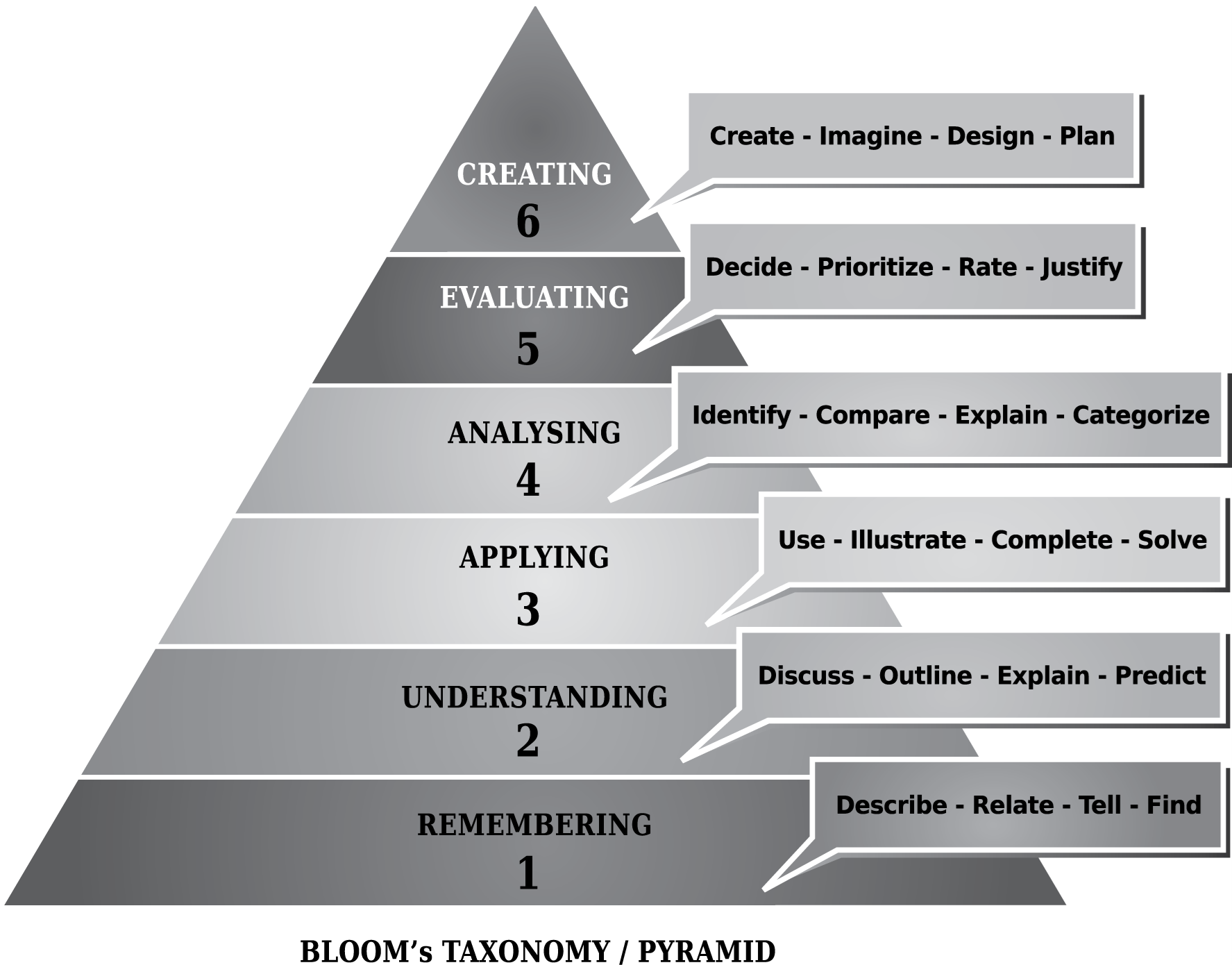
a diagram showing Bloom's Taxonomy Pyramid

A diagram showing Bloom's Taxonomy Pyramid of the six levels of cognitive learning. Each level includes a comment balloon containing associated action verbs. Starting from the base to the top of the pyramid, the first level is Remembering, which includes the verbs describe, relate, tell, and find. The second level is Understanding, which includes the verbs discuss, outline, explain, and predict. The third level is Applying, which includes the verbs use, illustrate, complete, and solve. The fourth level is Analyzing, which includes the verbs identify, compare, explain, and categorize. The fifth level is Evaluating, which includes the verbs decide, prioritize, rate, and justify. The sixth and final level is Creating, which includes the verbs create, imagine, design, and plan.

Instructors at all levels have used Bloom's taxonomy to determine cognitive levels for classroom activities (McCormick & Whittington 2000), to categorize question-asking (Schurr 2001; Shaunessy 2000), and to assist in differentiating instruction (Distad & Heacox 2000). It has been used to assess the cognitive levels of test bank questions (Masters et el. 2001) as well as the test questions posed in textbooks (Risner, Nicholson, & Webb 2000), and to classify levels of classroom questions (Magner 2000). Another novel use has been to encourage greater cognitive complexity in school counselor training (Granello 2000).

Perhaps the taxonomy's greatest contribution has been in the development of a professional language. Teachers and administrators who describe and analyze instruction know that terms such as knowledge level and higher levels of learning will be understood by educators everywhere. This universal vocabulary, reflecting a specialized body of knowledge, was an essential step in the professionalization of teaching (Danielson 2007).

The importance of the comprehension category as a gateway to the other levels is also becoming clear. In a retrospective review of this area of cognitive psychology, Raymond Nickerson (1985) argued convincingly that comprehending an idea or a concept is an essential prerequisite to applying it, analyzing it, or using it creatively or evaluatively. Thus, teachers need to make a special effort to ensure that students understand an idea before asking them to use it.

Don Orlich (1991) has raised some questions about the sequence to the levels. Although he supports the general idea of increasing cognitive complexity, he questions whether progress through the taxonomy occurs in six uniform steps. His observations led to the conclusion that comprehension is the key to upper categories. This is a practical problem that you can test by making observations and collecting data in your own classes, a process called "Action Research" (see Mertler 2008 and Riel 2010 for extended treatments of the topic). The overriding message is clear: if your students are to learn effectively, then you need to plan and implement strategies that require internal processing of information. Establish goals, lay a knowledge base, and teach actively toward higher cognitive levels.
Sample Strong Response and Scoring Rubric for Assignment 7

The middle school leadership team's walkthrough data reveals a critical area for improvement: the predominance of lower-order thinking questions in classrooms. To address this and improve student performance on standardized assessments, the teacher leader can leverage PLCs to foster a shift towards higher-order thinking.

The teacher leader should begin to build consensus in the PLC's by presenting the walkthrough data (Document 1) showing the prevalence of fact-based questions. Connecting this directly to the school's below-anticipated performance on state assessments (Document 2) will establish a clear need for change. Framing the issue as a shared challenge, rather than individual teacher deficits, is crucial. The teacher leader can then introduce research from Document 3, highlighting Bloom's Taxonomy as a widely accepted framework for categorizing cognitive levels. Emphasizing the taxonomy's role in developing a common professional language will help teachers understand the purpose and value of incorporating higher-order thinking questions. Facilitating a discussion around the benefits of such questions, like improved critical thinking and deeper understanding, can further solidify consensus.

Some key factors the teacher leader will need to consider are:

Current Questioning Practices: Analyze walkthrough data (Document 1) to establish a baseline understanding of the types of questions currently being asked. Supplement this with classroom observations focused specifically on questioning techniques.

Teacher Knowledge and Beliefs: Survey teachers to gauge their knowledge of Bloom's Taxonomy and their understanding of the importance of higher-order thinking. This can reveal any misconceptions or knowledge gaps that need to be addressed.

Curriculum Alignment: Review existing curriculum materials to identify opportunities for incorporating higher-order thinking questions and activities.

A practical PLC activity, incorporating the excerpt from Document 3, involves collaborative lesson planning focused on higher-order thinking. Teachers can work in grade-level teams to revise existing lessons, intentionally incorporating questions from the higher levels of Bloom's Taxonomy. The research in Document 3 provides specific examples of how the taxonomy has been used to categorize question-asking. Teachers can use these examples as models for crafting their own questions. Furthermore, the emphasis on comprehension as a "gateway" to higher-order thinking in Document 3 should be a central focus of the PLC. Teachers should practice designing lessons that first ensure student comprehension before progressing to application, analysis, evaluation, and creation. This activity allows for collaborative learning, peer feedback, and practical application of the research.

To monitor the effectiveness of the implemented strategies, teachers can collect several types of data:

Student Work Samples: Analyzing student responses to higher-order thinking questions on assignments and assessments provides direct evidence of their developing skills.

Classroom Observations: Follow-up walkthrough observations focused on questioning techniques can track changes in classroom practice.

Teacher Reflection Journals: Encouraging teachers to reflect on their implementation of higher-order questioning and the impact on student learning provides valuable qualitative data.

By consistently monitoring these data points, the teacher leader and PLC teams can identify areas of success, address challenges, and make necessary adjustments to maximize the impact of their efforts on student learning. This data-driven approach ensures continuous improvement and promotes a culture of reflective practice, which helps lead to a shift toward higher-order thinking questions.

Scoring Rubric

Performance Characteristics for the Assignment

Completion The degree to which the candidate completes the assignment by responding to each specific task in the assignment.
Application of Content The degree to which the candidate applies the relevant knowledge and skills to the response accurately and effectively.
Support The degree to which the candidate supports the response with appropriate evidence, examples, and explanations based on the relevant content knowledge and skills.

Score Scale for the Assignment

The four points of the scoring scale correspond to varying degrees of performance.

Score Point Score Point Description
4 The "4" response reflects a thorough understanding of the relevant content knowledge and skills.
  • The response fully addresses all parts of the assignment.
  • The response demonstrates an accurate, highly effective application of the relevant content knowledge and skills.
  • The response provides strong, relevant evidence, specific examples, and well-reasoned explanations.
3 The "3" response reflects a general understanding of the relevant content knowledge and skills.
  • The response addresses most or all parts of the assignment.
  • The response demonstrates a generally accurate, effective application of the relevant content knowledge and skills.
  • The response provides sufficient evidence, some examples, and generally sound explanations.
2 The "2" response reflects a limited understanding of the relevant content knowledge and skills.
  • The response addresses at least some of the parts of the assignment.
  • The response demonstrates a partially accurate, partially effective application of the relevant content knowledge and skills.
  • The response provides limited evidence and examples or explanations, when provided, may be only partially appropriate.
1 The "1" response reflects little or no understanding of the relevant content knowledge and skills.
  • The response addresses, few, if any, parts of the assignment.
  • The response demonstrates a largely inaccurate, ineffective application of the relevant content knowledge and skills.
  • The response provides little to no evidence, and if provided, examples or explanations are weak or inappropriate.
U The response is unscorable because it is unreadable, not written to the assigned topic, is written in a language other than English, or does not contain a sufficient amount of original work to score.
B There is no response to the assignment.

Assignment 8

(Objective 0008) Analyze and interpret information about instruction and student progress (e.g., student work samples, results of assessments, excerpts of coaching discussions) to support a teacher within a coaching cycle.

Scenario

Use the information provided to complete the assignment that follows.

A teacher leader observes a teacher deliver a lesson on adding and subtracting two- and three-digit numbers. Based on previous lessons and assessments, the students are proficient in adding and subtracting numbers up to 10 and the class is generally working toward achieving proficiency in extending these operations to numbers up to 20. They are also learning to compare numbers up to 1,000.

Prior to the current lesson, students practiced adding and subtracting sums involving two and three digits without regrouping for three days. The teacher chose problems that did not involve "regrouping values" (e.g., When adding 18 + 12, the sum of 8 + 2 can be considered a group of 10 ones or "regrouped" into a group of one 10).

In the current lesson, the teacher extends students' understanding by teaching them how to add two- and three-digit problems that involve regrouping and modeled how to solve a few problems. When the teacher finished their presentation, they gave each student a five-question activity to check for understanding.

The teacher leader considers the teacher's lesson plan, the formative assessment they used to assess students' understanding at the end of class, and a discussion that the teacher led with the class.

Develop a response of 400 to 600 words in which you:

Document #1: Lesson Plan

Learning Goal
Students will be able to add 2- and 3-digit numbers in problems that require regrouping.

Georgia Standards for Excellence (GSE)

3.PAR.2. Use part-whole strategies to represent and solve real-life problems involving addition and subtraction with whole numbers up to 10,000.

3.PAR.2.1. Fluently add and subtract within 1000 to solve problems.

Lesson Materials

Printed copies of independent practice activity

Individual whiteboards

Fine tip dry-erase markers

Lesson Activities

Warmup Activity (5 minutes)

  • Addition problem with numbers less than 100 (without regrouping)
  • Subtraction problem with numbers less than 100 (without regrouping)
  • Independent work time, review as a group

Reteaching Whole-Class Activity (10 minutes)

  • Class sits on front carpet
  • Solve addition problem involving regrouping as a class
  • Call specific attention to place value of each digit, and the place value justification for regrouping

Partner Practice Activity (10 minutes)

  • Pair students with “shoulder partners”, distribute whiteboards and dry-erase markers
  • One student verbally describes steps to complete to the other, while the other records them on the whiteboard
  • Pairs raise hands when they finish the problem, verify their answer with teacher, and switch roles

Independent Practice Activity (10 minutes)

  • Pass out independent practice activity
  • Circulate and identify students who need assistance
  • When enough students finish, have students grade their own papers as teacher reads answers
  • Students include brief reflection about their confidence solving problems like these on bottom of practice activity

Summary Discussion (5 minutes)

Discussion questions

  • "Did anyone realize they made a mistake while solving the problems today? What was it?"
  • "What do you do when you need to remember lots of instructions or steps?"
  • "How do you know a problem will have regrouping when you first look at it?"

Document #2: Independent Practice Activity

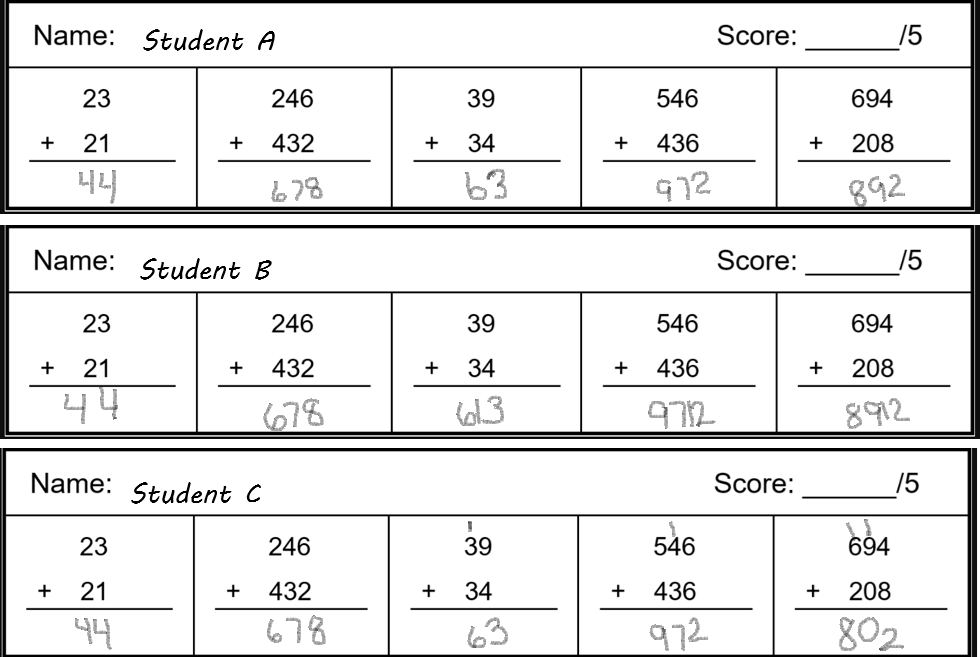
three math activity sheets

Three math activity sheets with the same five addition problems are shown for students A B and C. The first row of the sheet includes fields for the student's name and their possible score out of 5 points. The second row includes the following addition problems from left to right: 23 plus 21, 246 plus 432, 39 plus 34, 546 plus 436, and 694 plus 208.

Student A calculated the following sums for these problems: 44, 678, 63, 972, and 892.

Student B calculated the following sums for these problems: 44, 678, 613, 9712, and 8912.

Student C calculated the following sums for these problems: 44, 678, 63 with a one above the tens place, 972 with a one above the tens place, and 802 with ones above both the hundreds and tens place.

The average score on this activity was a 2.4 out of 5. Most students answered the first two problems correctly (i.e., 23 + 21 and 246 + 432, the two problems that do not involve regrouping). Answers varied significantly on the remaining three problems. The teacher decided to reteach the skill in a whole-group activity the following day.

Document #3: Excerpt of Conversation

The teacher called the class to the front carpet and wrote the equation 393 + 341 on a large sheet of chart paper.

Teacher: Who can read this top number for me?

Student A: Three hundred ninety-three.

Teacher: Nice work. How about the bottom number?

Student B: Three hundred forty-one.

Teacher: Excellent! So, we are going to be adding 393 and 341. Those are some really big numbers to add together. What addition problem should we start with in our head?

Student C: Three plus three!

Teacher: Why do you think we should start with three plus three?

Student C: Because that's the first numbers there are.

Teacher: You are right, when we read the numbers, we read left to right and would start with the threes. But remember, when we are adding numbers, we start in the ones place, which is all the way to the right. So, thinking about our ones place, what is the first addition problem we need to solve?

Student D: Three plus one!

Teacher: Yes! The addition problem we need to start with in our ones place is three plus one. What is the answer to three plus one?

All students: FOUR!

Teacher: Yes, three plus one equals four. We know that one. We will write the number four in our answer space under the one. Where should we go next?

Student E: Ummm, the nine and the four?

Teacher: Yes! We solved the problem in the ones place and now we are moving to the tens place to solve that addition problem. Can you tell me what nine plus four is?

Student E: Thirteen?

Teacher: That's right, the answer is thirteen. Where do I put the thirteen?

Student F: In the answer space under the four!

Teacher: Okay, it should go under the part of the problem we just solved. Can I fit the thirteen in that space? Let's try it … Hmmm. It doesn't fit. Who remembers what we should do next?

Sample Strong Response and Scoring Rubric for Assignment 8

The teacher demonstrates a clear strength in engaging students and facilitating classroom discussion. In the excerpt (Document 2), the teacher uses questioning to guide students through the process of adding three-digit numbers. They encourage participation and affirm student contributions, creating a positive learning environment. However, the lesson reveals an area for growth in scaffolding instruction and addressing student misconceptions related to regrouping. The students' hesitation and uncertainty when encountering a sum greater than ten in the tens place ("Hmmm. It doesn't fit. Who remembers what we should do next?") suggests a need for more explicit instruction and practice with this concept. The low average score of 2.4 out of 5 on the independent practice activity (Document 3), particularly on problems involving regrouping, further underscores this need.

The teacher leader could introduce the Concrete-Representational-Abstract (CRA) instructional strategy within a coaching cycle. CRA is a three-step approach that uses concrete manipulatives, visual representations, and abstract symbols to help students develop a conceptual understanding of mathematical concepts. In this case, the teacher could use base-ten blocks (concrete) to represent the numbers being added, then draw diagrams or pictures of the blocks (representational), and finally move to the abstract algorithm.

The teacher leader can guide the teacher to leverage their strength in interactive questioning by incorporating those questions into each stage of the CRA sequence. As the teacher models with base-ten blocks, they can simultaneously engage students with questions like, "How many ones do we have now? If we have ten ones, can we trade them for a ten? Where do we put that ten?" Similarly, when transitioning to the representational phase, the teacher can continue their questioning while connecting the drawings to the concrete manipulatives: "How can we draw a picture to show what we did with the blocks? How does this picture show the regrouping?" This approach allows the teacher to maintain their effective communication style while providing students with multiple representations of the concept. By incorporating CRA, the teacher addresses the area of growth by providing opportunities for active engagement and conceptual understanding, moving beyond rote memorization of the algorithm. This directly addresses the students' struggles with regrouping evident in the excerpt (Document 2) and the independent practice results (Document 3).

The teacher leader could monitor the progress of implementing the CRA strategy by gathering baseline data on the teacher's current instructional practices and student understanding of regrouping. This might include observing student responses to questions and analyzing student work samples. After co-planning a lesson incorporating CRA, the teacher leader observes the teacher implementing the CRA strategy, providing specific feedback and support related to their use of the strategy and its impact on student understanding. In order to provide tangible evidence of student progress and identify any lingering misconceptions, the teacher collects student work samples from each stage of the CRA process (concrete, representational, abstract) to assess their understanding of the concept. The teacher can also use formative assessments, such as exit tickets or short quizzes, specifically targeting problems that involve regrouping, to monitor student progress and identify areas where further instruction is needed. This can guide the teacher to reflect on their implementation of CRA and its impact on student learning, documenting observations and challenges in a journal. This reflective practice encourages continuous improvement and allows the teacher to identify areas where they need further support from the teacher leader.

Scoring Rubric

Performance Characteristics for the Assignment

Completion The degree to which the candidate completes the assignment by responding to each specific task in the assignment.
Application of Content The degree to which the candidate applies the relevant knowledge and skills to the response accurately and effectively.
Support The degree to which the candidate supports the response with appropriate evidence, examples, and explanations based on the relevant content knowledge and skills.

Score Scale for the Assignment

The four points of the scoring scale correspond to varying degrees of performance.

Score Point Score Point Description
4 The "4" response reflects a thorough understanding of the relevant content knowledge and skills.
  • The response fully addresses all parts of the assignment.
  • The response demonstrates an accurate, highly effective application of the relevant content knowledge and skills.
  • The response provides strong, relevant evidence, specific examples, and well-reasoned explanations.
3 The "3" response reflects a general understanding of the relevant content knowledge and skills.
  • The response addresses most or all parts of the assignment.
  • The response demonstrates a generally accurate, effective application of the relevant content knowledge and skills.
  • The response provides sufficient evidence, some examples, and generally sound explanations.
2 The "2" response reflects a limited understanding of the relevant content knowledge and skills.
  • The response addresses at least some of the parts of the assignment.
  • The response demonstrates a partially accurate, partially effective application of the relevant content knowledge and skills.
  • The response provides limited evidence and examples or explanations, when provided, may be only partially appropriate.
1 The "1" response reflects little or no understanding of the relevant content knowledge and skills.
  • The response addresses, few, if any, parts of the assignment.
  • The response demonstrates a largely inaccurate, ineffective application of the relevant content knowledge and skills.
  • The response provides little to no evidence, and if provided, examples or explanations are weak or inappropriate.
U The response is unscorable because it is unreadable, not written to the assigned topic, is written in a language other than English, or does not contain a sufficient amount of original work to score.
B There is no response to the assignment.